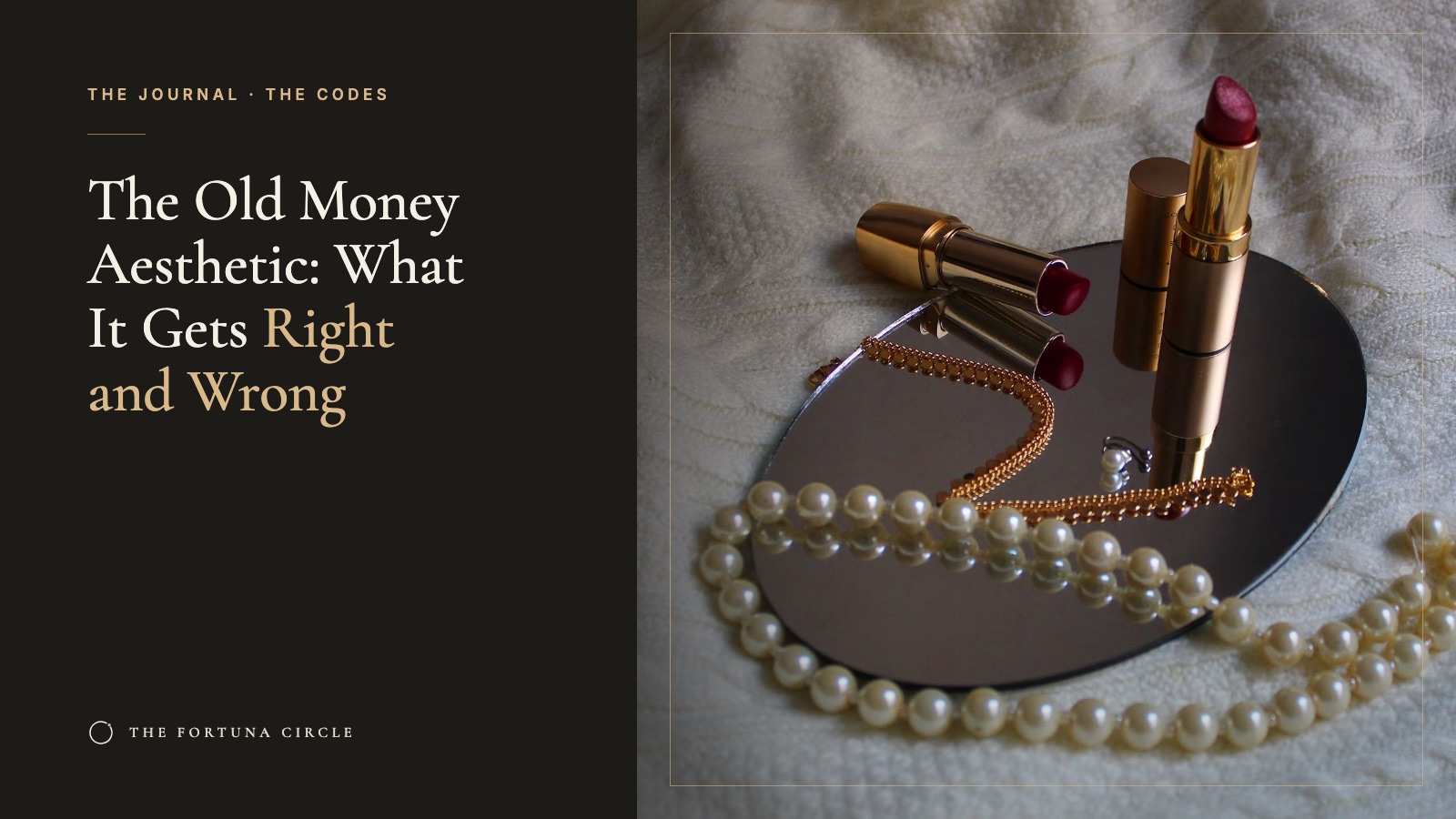
The old money aesthetic is an online trend that tries to look like inherited wealth: neutral colors, knitwear, loafers, pearls, glossy hair, no logos. It gets one big thing right and several important things wrong, and the gap matters if you actually spend time in old-money circles, where people can tell the look from the life in about two seconds.
This piece is not a shopping list. It’s a field guide: what the trend understands, what it misses, and how a woman over 40 can carry the real thing without looking like she’s in costume.

Main Street, cobblestones, a line outside the bakery. Just ahead, a woman of about twenty-five: crisp cable-knit sweater draped over her shoulders, spotless loafers, pearl studs, a sleek blowout. Her friend is filming her walking past the storefronts.
Behind them, a woman of about sixty in a faded navy sweater with a darned elbow, sun-streaked gray bob, boat shoes scuffed white at the toes, a canvas tote that has clearly seen twenty summers. No makeup that you can see. She’s holding a dog leash and a paperback.
Three people stop to talk to her in the time it takes to buy a loaf of bread. Nobody stops the first woman. She’s the one dressed “old money.” The other one simply is.
What is the old money aesthetic?
The short answer: a style trend that took off on TikTok and Pinterest in the early 2020s, borrowing the visual codes of families who have had money for generations. Think country-club tennis whites, navy and cream, tailored trousers, cashmere, riding boots, a single strand of pearls, hair that looks expensive and effortless. It overlaps with “quiet luxury,” its more fashion-industry cousin.
It’s aspirational by design. Most of the images are staged, filtered and styled for people in their twenties. That isn’t a crime. It just means that what you’re looking at is a picture of old money, not old money itself, and the two differ in the markers that actually count.
What the trend gets right
Credit where it’s due. The trend understands four real things:
- Restraint. No logos, no flash, nothing that shouts a price. That is genuinely how inherited wealth dresses.
- Quality over quantity. Fewer things, better made, bought to last. The fabrics are right: wool, cotton, linen, cashmere, leather.
- Grooming. Clean hair, clear skin, neat nails. The trend is right that the look depends on upkeep more than on any single item.
- Timelessness. Navy, cream, camel, gray. Colors and cuts that were acceptable in 1985 and will be acceptable in 2045.
If the trend has moved anyone away from logo-heavy dressing and toward fewer, better things, it has done some good.
Before going further: do you know which of the four barriers actually blocks you? Take the Four Circles Test — three minutes, free.
What it gets wrong
Here is where the costume shows.
It’s too new. Real old money is worn. Shoes resoled three times, a sweater from the last century, a watch that was a grandfather’s, a tote gone soft. Patina is the point. A head-to-toe outfit bought last month, however beige, reads as new money trying.
It’s made to be seen. The whole trend lives on camera. Real old money is private to the point of allergy: no posting the house, the boat, the club or the table. The moment it’s performed, it’s no longer the thing.
It’s only clothes. The trend stops at the neckline. The real signals are behavior: how you speak to staff, how you write a thank-you note, how you talk about money (you don’t), how quietly you arrive. That’s the part the camera can’t film, and the part that decides whether you’re invited back.
It’s styled for 25. Blowouts, “glass skin,” almond nails, a big pearl choker. On a woman of 45 the same formula tips into dressing up as someone else.
It’s one look. There is no single old money style. The Upper East Side, Beacon Hill, Palm Beach, Charleston and Nantucket each have their own uniform, and they would all find each other slightly wrong. In the UK, it’s a waxed jacket with a torn pocket and boots that have seen actual mud in the Cotswolds.
Old money aesthetic vs real old money
| The aesthetic | The real thing | |
|---|---|---|
| Clothes | New, coordinated, head to toe | Old, mended, mixed with no thought |
| Hair | Blowout, uniform blonde | Clean, well cut, often air-dried, gray allowed |
| Skin | Contoured, “glowy,” filtered | Clear, sun-protected, visibly real |
| Nails | Long almond, “clean girl” nude | Short, filed, bare or classic red |
| Jewelry | Big pearls, stacked gold | One inherited piece, worn daily |
| Scent | The fragrance of the season | The same one for twenty years, barely there |
| Where it lives | On your feed | Nowhere you can see |
How to look old money over 40
Not by buying a wardrobe. By doing the unglamorous things, consistently, for long enough that they show. The wardrobe side has its own guide; here is everything else.
Hair
A good cut, maintained every eight to ten weeks, matters more than any styling. A color close to your own, or gray that is kept bright and healthy. Low bun, low ponytail, loose and a little undone; a tortoiseshell clip or a velvet headband if you like. No extensions, no visible flat iron, no salon waves that hold for three days.
Skin
Sunscreen every day, a short routine you actually keep, a dermatologist once a year. A light tan from being outdoors is part of the American version; a tanning-bed glow or bronzer is not. If you have anything done, the rule is that nobody should be able to tell: we explain how to go about it in our piece on subtle tweakments after 40.
Makeup
Every product should disappear into your face. Concealer where needed, brows brushed up, mascara, a balm by day and a classic red at night if you wear lipstick at all. No contouring, no glitter, no lash extensions.

Hands and teeth
Nails short, filed and clean, bare or with a sheer, nude or classic red polish. Hand cream after every wash. Teeth healthy and naturally white: the ultra-white, too-perfect veneer smile reads as recent money in these circles, not old.
Scent
One fragrance, worn for years, until people associate it with you without being able to name it. Someone should notice it only when they lean in to kiss your cheek, never when you walk into a room.
Manners
The part no trend can sell you: a lowered voice, unhurried movements, real attention to the person in front of you, and never, ever a price. The mistakes that mark you in these circles are almost all behavioral.
Cable-knit over the shoulders, brand-new loafers, pearl choker, blowout, almond nails, a monogram on everything, and a photo of the club sign on her story. Every item is technically “on trend.” Together they read as a costume, because what gives old money away is precisely the absence of effort, and here the effort is the whole show. The woman who belongs would wear one of those things, badly ironed, and not think about it again.
Hair washed the night before and air-dried, a low ponytail. Sunscreen, concealer, mascara, balm. Nails filed short, bare. Small pearl studs, a watch you’ve had for years, nothing around the neck. One touch of fragrance on the wrist. Total time: twenty minutes. Nobody will remark on anything. That is the success.

Is the old money aesthetic cringe?
Sometimes, yes, and it’s worth knowing why. It becomes cringe when it’s cosplay: a borrowed identity, worn for the camera, with a subtext of “I’m from money” that isn’t true. Critics also point out that it romanticizes exclusion. Both criticisms are fair.
But the underlying habits aren’t cringe at all. Buying less and better, taking care of what you own, keeping your grooming simple and consistent, lowering your voice, never mentioning prices: these are just good manners and good sense. Take the habits, leave the costume.
Frequently asked questions
What is the old money aesthetic?
An online style trend, popular on TikTok and Pinterest since the early 2020s, that imitates the look of families with inherited wealth: neutral colors, classic tailoring, knitwear, loafers, pearls, well-kept hair and no logos. It captures the restraint of old money but not its age, privacy or manners.
How do you look old money over 40?
Focus on upkeep rather than outfits: a well-maintained haircut, a natural or well-kept gray color, sun-protected skin, short neat nails, one discreet fragrance, and clothes that are good, well fitted and allowed to age. Then the behavior: a quiet voice, courtesy to everyone, no talk of money.
What’s the difference between old money aesthetic and quiet luxury?
They overlap. “Quiet luxury” is the fashion industry’s term for expensive clothes without logos. The old money aesthetic adds a lifestyle fantasy: tennis clubs, sailing, country houses. Neither is the same as actual old money, which is mostly about age, habit and discretion.
Is the old money aesthetic cringe?
It can be when it’s worn as a costume or used to imply a background you don’t have. The underlying principles, fewer and better things, good grooming, restraint, are simply elegant.
What does old money hair look like?
Clean, healthy and well cut rather than heavily styled. Usually a color close to natural or a well-kept gray, often worn in a low bun, a low ponytail or loose and slightly undone. Regular trims matter more than blowouts.
- Metropolitan — Film by Whit Stillman, 1990 — Young Upper East Side debutantes and escorts during a Christmas season of parties. The most accurate film ever made about old money’s manners, anxieties and understatement.
- The Talented Mr. Ripley — Film by Anthony Minghella, 1999 — A young man studies the clothes, the vocabulary and the manners of old money to perfection. Watch what still gives him away.
- The Official Preppy Handbook — Lisa Birnbach (ed.), 1980 — Written as a parody and read as a manual. It explains where the online costume comes from, and why worn-out is the point.
- Old Money: The Mythology of America’s Upper Class — Nelson W. Aldrich Jr., 1988 — Written from the inside by a man born into it: the schools, the clubs, the horror of display.